Impact Factor: 0.6




LLHE
Language Learning in Higher Education (LLHE): the Journal of CercleS
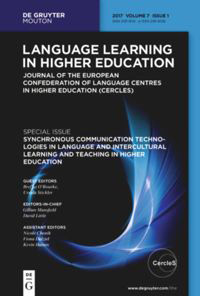
Language Learning in Higher Education
Journal of the European Confederation of Language Centres in Higher Education (CercleS)
Editors-in-Chief: Carmen Argondizzo and Anne Chateau
About this journal
Language Learning in Higher Education (LLHE) is the Journal of CercleS, the European Confederation of Language Centres in Higher Education. Its primary aim is to disseminate the most significant outcomes of research conducted within university Language Centres (LCs) and Higher Education Departments, while also providing a platform for professionals in language studies to exchange ideas and pedagogical approaches adopted in LCs. In the long term, this goal seeks to contribute to enhancing the overall quality of language education offered by the Higher Education language community across Europe and beyond.
From this perspective, LLHE serves as a forum for authors from the CercleS community and for international practitioners in language education, promoting diversity as an added value for CercleS members and offering a platform for colleagues outside the European context. It represents a meeting point where research and teaching experiences in the field of language studies are shared and further developed, fostering the collaborative spirit that characterises this multifaceted European Confederation.
The Journal deals with the most relevant aspects of modern language learning and teaching in university contexts and on the outcomes of research on fields of studies such as language education, applied linguistics, humanistic approaches to language learning, multilingualism, intercultural communication, inter-comprehension, academic language competences, creativity in language education, autonomous learning, methodology and didactic approaches, language assessment, CLIL, EMI, language education for sustainable development, quality assurance, university language policies, the exploitation of digital technologies and artificial intelligence. Specifically, it focuses on the description of successful activities and good practice applied in University Language Centres in Europe and in any other country; the role, status and management of Language Centres; the professional development of Language Centre staff.
The Journal includes two sections dedicated to: a) Research Articles; b) Activity Reports, which can be based on teaching and learning activities, reports and surveys about specific university contexts. As for details about the length of texts, authors can refer to the editorial submission guidelines that are mandatory for the acceptance of the articles and reports submitted.
The Journal is published twice a year, in May and October. As a reference point to the past years, Issues include a special one 10.2 (2020), Enhancing the Role of European University Language Centre: past achievements and future perspectives, the aim of which was to celebrate the 30th anniversary of CercleS (1991-2021). A webinar was organised in Spring 2021 for this special event. The recording of the webinar can be found on YouTube.
LLHE 11.1 and 11.2 (2021) include several contributions presented at the XVI CercleS Conference held at Masaryk University (Brno) in September 2020.
The 2022 Issues (12.1, 12.2) include a special section on Language Education for Sustainable Development and other research articles covering topics related to language learning and activities carried out within Language Centres communities.
The 2023 Issues (13.1, 13.2) comprise several contributions arising from the XVII CercleS Conference, hosted by ReCLes.pt – the Association of Language Centres in Higher Education (Portugal) – at ISCAP, the Porto Accounting and Business School (September 2022).
In 2024, Issues 14.1 and 14.2 of the Journal continued to feature articles that give voice to diverse experiences in language education from around the world.
The 2025 Issues (15.1, 15.2) comprise contributions arising from the XVIII CercleS Conference hosted by AULC – the Association of University Language Centres in the UK and Ireland – at Durham University in September 2024.
The 2026 Issues (16.1, 16.2) feature further publications devoted to CercleS members and independent authors.
CercleS also organises webinars dedicated to the Journal, providing opportunities to explore and discuss themes related to articles published in LLHE. These webinars feature dynamic and engaging interviews with the authors. Detailed information and recordings of the webinars can be found on the CercleS YouTube channel.
Your Benefits
- Journal of the prestigious European Confederation of Language Centres in Higher Education
- Dedicated to disseminating the best results of research activities carried out at Language Centres and Higher Education Departments
- All articles subjected to double-blind peer review process
Abstracting and Indexing
Language Learning in Higher Education is covered by the following services:
- Baidu Scholar
- Cabells Journalytics
- CNKI Scholar (China National Knowledge Infrastructure)
- CNPIEC – cnpLINKer
- Dimensions
- EBSCO (relevant databases)
- EBSCO Discovery Service
- Educational Research Abstracts Online
- ERIC (Education Resources Information Center)
- ERIH PLUS (European Reference Index for the Humanities and Social Sciences)
- Genamics JournalSeek
- Google Scholar
- IBR (International Bibliography of Reviews of Scholarly Literature in the Humanities and Social Sciences)
- IBZ (International Bibliography of Periodical Literature in the Humanities and Social Sciences)
- J-Gate
- JournalTOCs
- KESLI-NDSL (Korean National Discovery for Science Leaders)
- Linguistics Abstracts Online
- MLA International Bibliography
- MyScienceWork
- Naver Academic
- Naviga (Softweco)
- Norwegian Register for Scientific Journals, Series and Publishers
- Primo Central (ExLibris)
- ProQuest (relevant databases)
- Publons
- QOAM (Quality Open Access Market)
- ReadCube
- Research into Higher Education Abstracts
- Scilit
- SCImago (SJR)
- SCOPUS
- Semantic Scholar
- Sherpa/RoMEO
- Summon (ProQuest)
- TDNet
- Ulrich’s Periodicals Directory/ulrichsweb
- WanFang Data
- Web of Science – Emerging Sources Citation Index
- WorldCat (OCLC)
- X-MOL
- Yewno Discover
- Class A
Supplementary Materials
Topics
- Applied Linguistics
- First Language Acquisition
- Language Policy and Planning
- Language Teaching and Learning
- Linguistics and Semiotics
- Theoretical Frameworks and Disciplines
External Links
Please note De Gruyter’s Publishing Ethics here.
This link gives access to abstracts only:
If you are a full member of CercleS, you can log in to the website using your institutional login details and access the articles via: LLHE online copy. For access to publications: